
No products in the cart.
Return To Shop Need Help? Call Us At (925) 400-9986
Contact Us at info@anchormolecular.com

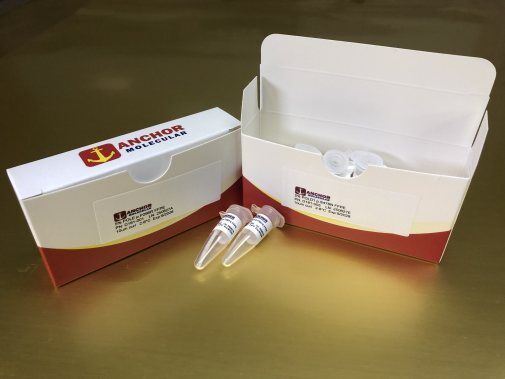
POLE-POLD1 mutations are changes in genes responsible for DNA replication and proofreading, leading to increased DNA mutations and a condition called Polymerase Proofreading-Associated Polyposis (PPAP) syndrome. These mutations increase the risk of various cancers, such as colorectal, endometrial, and brain cancers, but are often associated with a good prognosis and a high tumor mutational burden, which can make tumors more susceptible to immunotherapy.
The POLE-POLD1 Mutation Controls contain formalin-fixed, paraffin-embedded (FFPE) slices with embedded cellular DNA carrying POLE mutations on Exon 9 (P286R), Exon 11 (F367S), Exon 13 (V411L, c.1231 G>C ) and Exon 14 (S459F ) and a POLD1 mutation on Exon 12 (S478N), at ~5% allele frequency.
| Cat. No. | Variant Name | Target VAF(%) | Target gDNA (copy/curl) | DNA Mass(ng/curl) |
|---|---|---|---|---|
| D181-000 | Wildtype | 0% | 100,000-200,000 | ~200 |
| D181-001 | POLE p.P286R | 5% | 100,000-200,000 | ~200 |
| D181-002 | POLE p.F367S | 5% | 100,000-200,000 | ~200 |
| D181-003 | POLE p.V411L (G>C) | 5% | 100,000-200,000 | ~200 |
| D181-004 | POLE p.S459F | 5% | 100,000-200,000 | ~200 |
| D181-005 | POLD1 p.S478N | 5% | 100,000-200,000 | ~200 |
Documents
Sample Certification (COA)
(The COA for your order will be enclosed within the shipping package.)
| Lot # | Certificate Type | Catalog Number(s) |
|---|---|---|
| 250914 | Certificate Analysis | D181-000 |
| 250827a | Certificate Analysis | D181-001 |
| 250827b | Certificate Analysis | D181-002 |
| 250827c | Certificate Analysis | D181-003 |
| 250827d | Certificate Analysis | D181-004 |
| 250827e | Certificate Analysis | D181-005 |
Safety Data Sheets
 SDS POLE-POLD1 FFPE Mutation Controls
Product Insert
 PI for POLE-POLD1 Mutation FFPE Controls
POLE-POLD1 Mutation Control Brochure
